Open 7 Days a WeekEmergency: (780) 488-0124

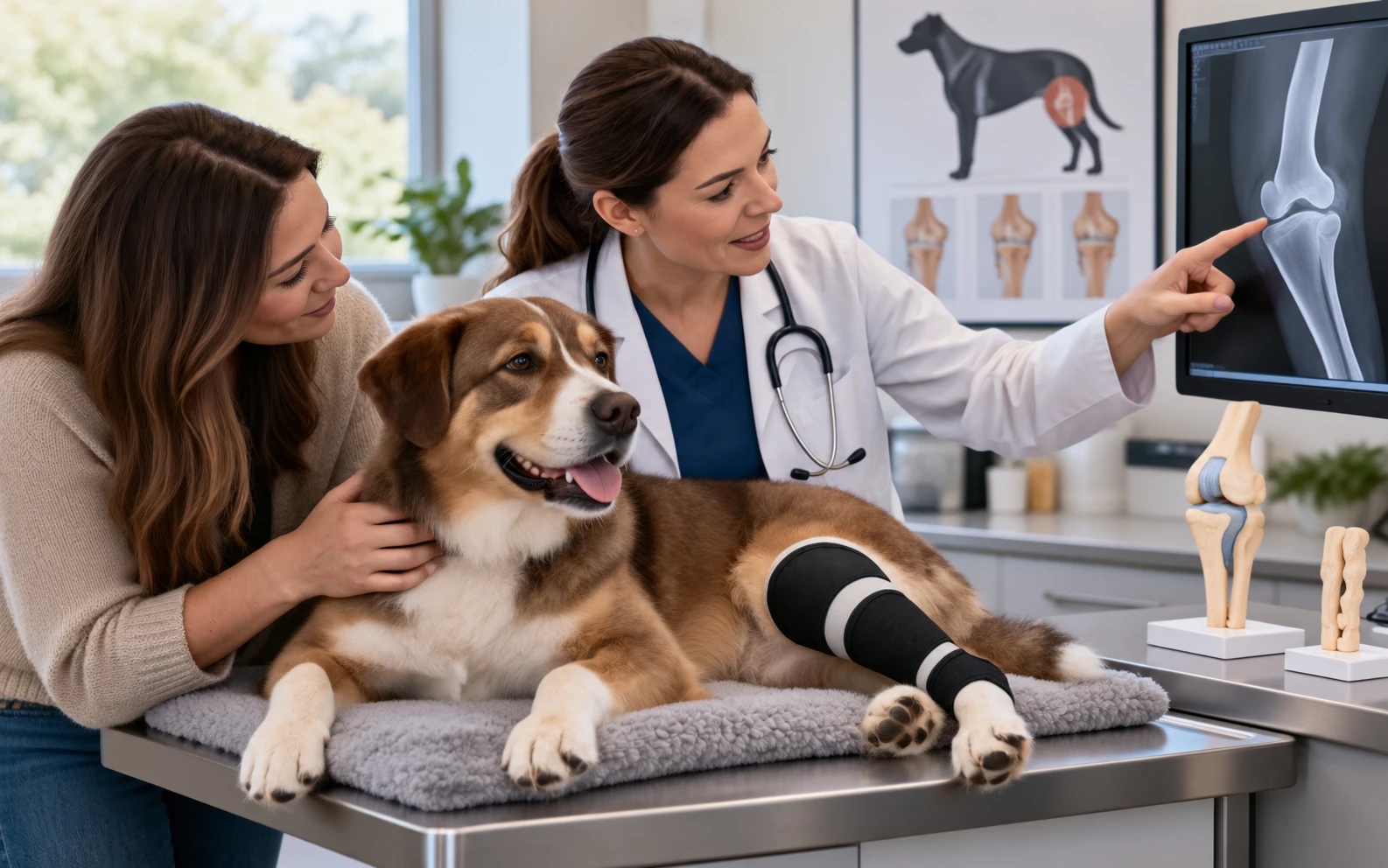
Your dog was running full-speed after a squirrel one moment, and limping on three legs the next and now a vet has just said the words "torn cruciate ligament" and "surgery" in the same sentence. If you're staring at three unfamiliar acronyms and trying to figure out which one will actually get your dog back on the trail, the pool, or the dog park, you're in the right place.
A torn cranial cruciate ligament (CCL), the canine equivalent of an ACL tear in humans, is one of the most common orthopedic injuries veterinarians treat in dogs. [Statistic placeholder: veterinary orthopedic surgeons report CCL rupture as the leading cause of hind-limb lameness in dogs, with an estimated $XXX million spent annually in the U.S. on treatment]. Yet despite how common it is, most pet parents have never heard of TPLO or TTA until the day they need to understand them fast, and under stress.
This guide breaks down all three major surgical approaches to cruciate repair in plain language, backed by what orthopedic veterinary literature actually shows about outcomes, cost, and recovery so you can walk into your consultation asking the right questions instead of just nodding along.
The cranial cruciate ligament stabilizes your dog's knee (stifle) joint, preventing the shin bone (tibia) from sliding forward relative to the thigh bone (femur). When it tears whether suddenly during play or gradually through degeneration the joint becomes unstable, painful, and prone to arthritis.
Key takeaway: Unlike human ACL tears, which are usually the result of a single traumatic event, canine cruciate ruptures are most often caused by progressive degeneration of the ligament over months or years, with the actual "tear" being the final straw rather than the whole story. This is a major reason surgery, not just rest, is typically recommended for anything beyond very small dogs.
If you're noticing these signs, read more about the signs of a torn ACL in dogs is a helpful next step before your appointment.
Many owners understandably want to try rest, anti-inflammatories, or a brace before committing to surgery. For very small dogs (under roughly 15 lbs), conservative management sometimes succeeds. For medium and large breed dogs, however, surgical stabilization is the standard of care recommended by veterinary orthopedic specialists, because an unstable knee continues to grind cartilage and accelerate arthritis with every step of surgery or not.
Studies comparing surgical vs. non-surgical management in dogs over 30 lbs show significantly higher long-term function and lower arthritis progression scores in surgically treated dogs.
This is where the three surgical options come in and where the real decision-making begins.
TPLO is currently the most widely performed and most extensively studied cruciate repair technique for medium to large breed dogs.
How it works: Rather than replacing the torn ligament, TPLO changes the geometry of the knee. The surgeon cuts the top of the tibia (the tibial plateau), rotates it to a more level angle, and secures it in place with a bone plate and screws. This eliminates the forward-sliding motion the cruciate ligament used to prevent so the knee is stable without needing the ligament at all.
Best suited for:
Pros:
Cons:
TTA takes a different mechanical approach to solve the same underlying problem.
How it works: The surgeon cuts and advances the tibial tuberosity (the bony bump where the patellar tendon attaches) forward, changing the angle at which the patellar tendon pulls on the tibia. This neutralizes the forward-sliding force during weight-bearing, similarly stabilizing the joint without relying on the native cruciate ligament.
Best suited for:
Pros:
Cons:
Also called lateral suture technique or "extracapsular repair," this is the oldest and most accessible of the three methods.
How it works: Instead of altering bone geometry, the surgeon places a strong synthetic suture on the outside of the joint capsule, mimicking the stabilizing function of the original ligament. Over time, scar tissue forms around the suture to provide long-term stability.
Best suited for:
Pros:
Cons:
Factor | TPLO | TTA | Traditional (Extracapsular) |
Best for dog size | Medium–giant, athletic | Medium–large | Small–medium |
Approximate cost* | $$$$ (highest) | $$$–$$$$ | $–$$ (lowest) |
Typical recovery to full activity | 12–16 weeks | 12–16 weeks | 16–20+ weeks (larger dogs) |
Surgeon availability | Specialist/board-certified | Specialist, less widely offered | Most general practice vets |
Long-term outcomes in large dogs | Excellent (best-studied) | Very good | Fair–good, higher failure risk |
Bone-cutting involved | Yes | Yes | No |
Cost ranges vary significantly by region, clinic, and case complexity see the cost section below for specifics.
Key takeaway: There is no single "best surgery for dog ACL tear" that applies to every case. The right choice depends heavily on your dog's size, age, activity level, and knee anatomy which is exactly why this decision should be made in partnership with your vet or a boarded veterinary surgeon, not by keyword alone.
This is one of the most common questions owners ask and the honest answer is: it depends on your dog.
For large, active, or working dogs, the veterinary literature is fairly consistent: TPLO tends to produce better long-term stability, lower revision rates, and faster, more complete returns to athletic function than extracapsular repair. [Statistic placeholder: comparative outcome studies show TPLO patients returning to X% of pre-injury function vs. Y% for extracapsular repair in dogs over 50 lbs].
For small and low-activity dogs, the gap narrows considerably; traditional repair often performs very well, heals reliably, and avoids the added cost and complexity of a bone-cutting procedure. In these cases, "better" often comes down to value and appropriateness rather than raw performance.
Practical example: A 6-year-old, 70 lb Labrador who hikes every weekend is a very different surgical candidate than a 9 lb senior Chihuahua with a partial tear and a sedentary lifestyle even though both technically have "a torn cruciate ligament."
Cost is often the deciding factor for owners weighing these three options, and it's fair to want real numbers before you commit for a detailed local pricing breakdown, see how much ACL repair costs for a dog in Edmonton.
In Edmonton and the surrounding area, TPLO surgery typically runs in the range of [cost placeholder confirm current clinic pricing], depending on:
By comparison, TTA costs are generally similar to TPLO, while traditional extracapsular repair tends to run noticeably lower, since it doesn't require the specialized plates, screws, and bone-cutting equipment TPLO and TTA rely on.
What's typically included in a quoted surgery price:
What's often billed separately:
If cost is a major concern, ask your clinic directly about payment plans, pet insurance pre-authorization, and whether a detailed written estimate is available before surgery day. A reputable clinic will always welcome this conversation rather than rush past it.
Recovery is where a lot of owners underestimate the commitment and where outcomes are often won or lost, regardless of which surgery you choose.
Most dogs recovering from TTA follow a similar general timeline to TPLO:
Key takeaway: The bone (not the incision) is the true timeline-driver for TPLO and TTA your dog may look fine at week 4, but the osteotomy site needs the full window to heal, which is why strict activity restriction matters even after your dog seems back to normal.
Because there's no bone-cutting involved, initial soft-tissue healing is often faster but the suture itself needs time for scar tissue to build around it for lasting stability, so full activity restriction still typically runs 12–20 weeks, and can run longer in larger, more active dogs.
Practical example: Two dogs of the same breed and surgery type can have very different recoveries; the one whose owner strictly enforces crate rest and follows a structured rehab plan typically returns to full function faster and with fewer complications than the one allowed to "test it out" early. For a real look at what this journey can involve, read Simon's story of TPLO recovery.
Large and giant breed dogs face unique challenges that make surgical choice especially important:
If you have a large breed dog, this is a conversation worth having directly with a veterinary surgeon who can evaluate your dog's specific tibial plateau angle, weight, and activity goals, not just their breed on paper.
Walking into your consultation prepared makes a real difference. Consider asking:
There's no universal winner in the TPLO vs. TTA vs. traditional cruciate repair debate: the right procedure is the one matched to your dog's size, age, activity level, and unique anatomy, guided by a vet who has actually examined your dog's knee. TPLO currently holds the strongest evidence base for large, active dogs; TTA offers a well-studied alternative with similar goals; and traditional extracapsular repair remains a reliable, accessible option for smaller, less demanding cases.
What matters most, regardless of technique, is a proper diagnosis, a surgeon experienced in the chosen procedure, and genuine commitment to the recovery and rehab process because that's what turns a successful surgery into a fully recovered dog.
Every knee and every dog is a little different, and the right next step starts with an accurate diagnosis, not a guess based on breed or weight alone. If your dog is limping, favoring a hind leg, or has already been diagnosed with a cruciate injury, our team is here to walk you through your options and help you feel confident about whatever you decide.