Open 7 Days a WeekEmergency: (780) 488-0124

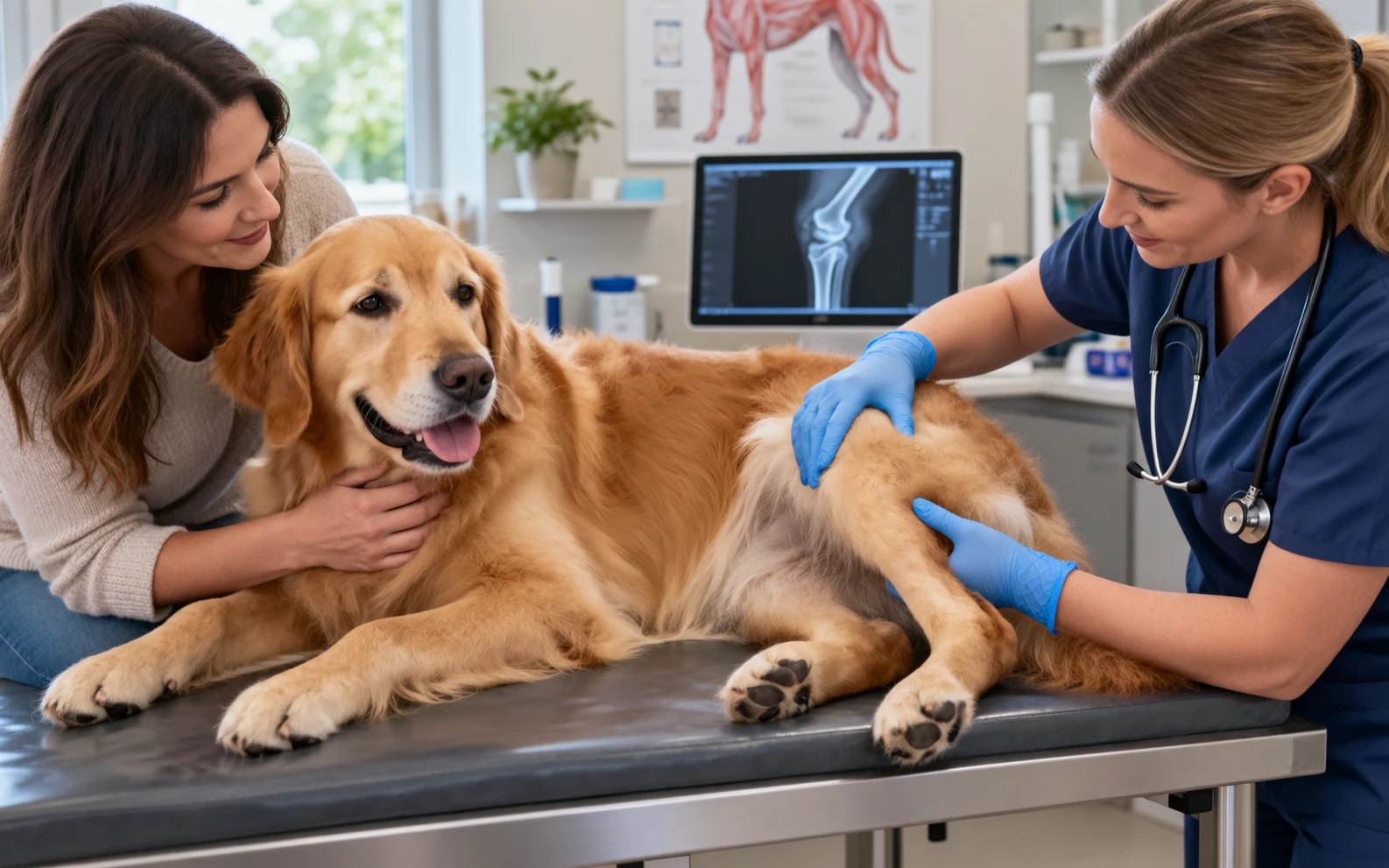
Your dog was fine yesterday. Today, they're holding one back leg off the ground like it doesn't belong to them anymore, and no amount of coaxing gets them to put weight on it. If that sounds familiar, you're probably not dealing with a simple sprain. You may be looking at one of the most common orthopedic injuries in dogs: a torn cranial cruciate ligament (CCL), the canine equivalent of a torn ACL.
This guide breaks down exactly what a cruciate tear looks like in real dogs, why it happens, and most importantly, what you should do in the next 24 to 48 hours to protect your dog's long-term mobility.
In human anatomy, we call it the ACL (anterior cruciate ligament). In dogs, the equivalent structure is called the cranial cruciate ligament (CCL), and it does the same job: stabilizing the knee (stifle) joint so the femur doesn't slide forward over the tibia during movement.
Key takeaway: When this ligament tears partially or completely the knee joint becomes unstable, painful, and prone to further damage, including meniscus tears, every time your dog puts weight on it.
Cruciate disease is one of the most frequently diagnosed orthopedic conditions in dogs, and veterinary orthopedic literature estimates it accounts for a significant share of canine hind-limb lameness cases seen in general practice each year [Statistic Placeholder: X% of canine orthopedic surgeries]. Large-breed, overweight, and middle-aged-to-senior dogs are disproportionately affected, though any dog, including small breeds and young, athletic dogs — can tear a cruciate ligament through sudden trauma.
If you're searching for signs of a torn ACL in dogs, chances are you've already noticed something. Here are the most reliable dog cruciate ligament injury symptoms, ranked roughly by how commonly they appear.
This is the single most common presenting sign. One moment your dog is running, jumping off the couch, or playing fetch — the next, they're limping or refusing to bear weight on a back leg. A dog limping back leg suddenly, especially after activity, is the classic hallmark of an acute cruciate tear.
Instead of fully avoiding the leg, some dogs will lightly touch the toe to the ground for balance while keeping the rest of the limb elevated. This partial weight-bearing pattern is common with partial ligament tears.
Watch how your dog sits. Dogs with cruciate injuries often can't fully flex the affected knee, so they'll sit with the injured leg extended out to the side rather than tucked neatly beneath them a sign veterinarians call a "positive sit test."
Getting up from a lying position, jumping into the car, or climbing stairs all require significant knee stability. Hesitation, stiffness, or outright refusal to do these activities is a red flag.
A clicking or popping sound when your dog walks can indicate a torn meniscus (the cartilage cushion in the knee), which frequently accompanies cruciate ligament tears, especially in cases that have gone untreated for weeks or months.
Inflammation and joint effusion (fluid buildup) often develop within 24–48 hours of the injury. The knee may feel warm, swollen, or thickened compared to the other side — vets call this thickening on the inside of the knee "medial buttress," and it's often a sign of chronic or long-standing instability.
If the injury has been present for a few weeks without treatment, you may notice the thigh muscle on the injured leg looking visibly smaller than the other side. This happens because your dog instinctively avoids using the leg, and unused muscle wastes away quickly.
Many dogs with cruciate disease are noticeably stiffer after naps or first thing in the morning, then seem to "loosen up" once moving though the limp rarely disappears entirely.
Pain changes behavior. A previously energetic dog who suddenly avoids the dog park, seems less interested in walks, or snaps when the leg is touched is communicating discomfort the only way they know how.
Practical example: A 6-year-old Labrador retriever chasing a ball in the yard yelps, comes up limping on a back leg, and within a day is barely touching the paw to the ground. This "sudden onset after activity" pattern is one of the most textbook presentations of an acute cruciate tear in veterinary practice. For a real look at what recovery can look like, read one Edmonton dog's own TPLO recovery journey.
While you can't diagnose a cruciate tear with certainty at home, there's a simple way to raise or lower your suspicion before your vet visit:
Bottom line: If your dog is holding up a back leg, especially after jumping, twisting, or rough play, this warrants a same-week (ideally same-day) veterinary exam. Only a physical orthopedic exam sometimes combined with X-rays or an MRI — can confirm a torn cruciate ligament.
Yes, and this is precisely what makes the injury so easy to underestimate. Many dogs will still walk, and even run, on a torn cruciate ligament, particularly with a partial tear. The knee is unstable, not paralyzed, so your dog can often compensate, especially in the early days.
Why this matters: Continuing to walk or run on an unstable knee accelerates joint damage, increases the risk of tearing the meniscus (if it hasn't torn already), and speeds up the onset of arthritis. Just because your dog can walk on it doesn't mean they should. Every step on an unstable knee is a step toward more permanent joint damage.
If your dog is walking on the leg but still showing any of the signs above (toe-touching, swelling, sitting abnormally), treat it as an emergency-adjacent situation — not a "wait and see."
Unlike human ACL tears, which are usually the result of a single traumatic event (think: a skiing accident or a bad landing on a basketball court), canine cruciate disease is often degenerative the ligament weakens gradually before it fails, sometimes with no single dramatic incident at all.
Common contributing factors include:
Once a cruciate tear is confirmed, treatment decisions depend on your dog's size, age, activity level, and the severity of the tear. Broadly, there are two paths:
For most medium-to-large dogs, surgery is the gold-standard recommendation because it restores joint stability and significantly reduces the long-term risk of arthritis and meniscus injury. Common surgical techniques include:
Non-surgical options may be considered for very small dogs, senior dogs with anesthesia risk, or owners for whom surgery isn't feasible. This typically includes:
Key takeaway: Conservative management can work for some dogs, particularly smaller, less active ones, but it generally carries a higher risk of ongoing instability, arthritis progression, and meniscus tears compared to surgical stabilization.
Not always, but surgery is recommended in the majority of cases involving medium-to-large or active dogs. Here's a general framework (always confirmed by your vet's individual assessment):
The honest answer: the "right" treatment is dog-specific. A thorough orthopedic exam and sometimes imaging is the only reliable way to know whether your dog is a good surgical candidate or a reasonable conservative-management case.
One of the most common questions pet parents ask once surgery is recommended is about cost. TPLO surgery for dogs typically costs more than other repair techniques because of the specialized equipment, implants, and surgical expertise required but it's also associated with strong long-term outcomes for return to normal activity.
Costs vary widely depending on:
[Statistic Placeholder: Regional TPLO cost range] - the best way to get an accurate number is a consultation and quote specific to your dog's size, condition, and your local clinic, since national or online averages often don't reflect real regional pricing. If cost is a concern, ask your veterinary team about payment plans, pet insurance coverage (ideally purchased before an injury occurs), or CareCredit-style financing options.
Delaying treatment doesn't make the problem go away it compounds it. Left unaddressed, an unstable knee typically leads to:
This is why early evaluation matters so much: the sooner a cruciate injury is diagnosed, the more treatment options are on the table, and the better the long-term outcome tends to be.
Contact a veterinarian promptly, ideally within 24–48 hours if you notice any of the following. (For a broader look at when a limp becomes a true emergency, see our top 10 critical signs your pet needs emergency care.)
If you're located in the Edmonton area, searching for a dog knee injury vet Edmonton pet parents trust for accurate diagnosis and a full range of treatment options from conservative management to surgical repair can make the difference between a fast recovery and a prolonged, painful one. If your dog's limp comes with sudden collapse, severe pain, or you're unsure whether it can wait, our emergency care team is available to help right away.
Don't wait for "wait and see" to turn into a bigger problem. Cruciate injuries rarely improve on their own, and early diagnosis is one of the biggest factors in a smooth, successful recovery. If your dog is showing any signs of a torn ACL from sudden limping to swelling to reluctance to jump — the team at Edmonton West Animal Hospital & Spay/Neuter Centre can provide a thorough orthopedic evaluation and walk you through every treatment option available, from conservative care to surgical repair.
Ready to get your dog moving comfortably again? Book an appointment with Edmonton West Animal Hospital & Spay/Neuter Centre today and get a clear diagnosis, a personalized treatment plan, and the peace of mind that comes with expert orthopedic care — right here in Edmonton.
Watch for sudden lameness on a back leg (especially after activity), reluctance to bear weight, sitting with the leg kicked out to the side, swelling around the knee, and stiffness that doesn't resolve within a day. A confirmed diagnosis requires a veterinary orthopedic exam, and sometimes imaging like X-rays.
Yes, many dogs, especially with partial tears can still walk or even run on an injured knee. However, continuing to bear weight on an unstable joint accelerates cartilage damage, increases the risk of a torn meniscus, and speeds up arthritis, so a dog's ability to walk on the leg is not a sign the injury is minor.
No, not every case requires surgery. Very small dogs or those with significant anesthesia risk may be managed conservatively with bracing, weight control, and restricted activity. However, most medium-to-large or active dogs, and any dog with a complete tear or meniscus damage, generally have better long-term outcomes with surgical stabilization such as TPLO.
TPLO cost varies significantly based on location, clinic, dog size, and any additional diagnostics or complications involved. Because national averages rarely reflect real local pricing, the most reliable way to know the cost for your dog is a direct consultation and quote from your veterinary team.
They refer to the same structure "ACL" is the human anatomical term, while veterinarians use "cranial cruciate ligament" (CCL) for the equivalent structure in dogs. Both terms describe the same type of knee instability injury.
A torn cruciate ligament does not heal or reattach on its own the way some soft tissue injuries can. Without surgical stabilization, the body may form scar tissue around the joint over time, which can provide some stability in certain dogs, but this process is unpredictable, often accompanied by significant arthritis, and generally considered less reliable than surgical repair for restoring normal function.